
 What a puzzle! Mai Lin was a nurse, studying
in an English program in another part of the city. It took an hour to cross
the distance. During the New Year's Festival that was okay, because we both
had time; but when the semester started both of our schedules were full.
That meant getting together on the weekends, and once we had done the usual
things, Mai Lin wanted to do something intelligent. Still, what was left?
I came from a strange land, so I might not like her choice, while I hardly
knew enough to select our destination myself. That meant every Friday Mai
Lin would call and ask "Where shall we go -- East, North, South, or
West?"
What a puzzle! Mai Lin was a nurse, studying
in an English program in another part of the city. It took an hour to cross
the distance. During the New Year's Festival that was okay, because we both
had time; but when the semester started both of our schedules were full.
That meant getting together on the weekends, and once we had done the usual
things, Mai Lin wanted to do something intelligent. Still, what was left?
I came from a strange land, so I might not like her choice, while I hardly
knew enough to select our destination myself. That meant every Friday Mai
Lin would call and ask "Where shall we go -- East, North, South, or
West?"
That
week I choose West. Mai Lin packed candy and quail eggs in her backpack,
and we were out the door by noon. We steered our bikes through the city,
down streets that seemed like caves of sycamores. Salesmen stood near
heaps of melons on canvas, and vendors clacked bamboos while they sang
about their herbs and tonics. Eventually the crowds and the carts thinned
out, and suddenly we were in the countryside. Above the roads stood walls
of tall poplars, and we could see stacks of brick in the distance, hazy
as a painting.
This
was the Central China Plain. Here a grid of black water splashed through
miles and miles of wheat, or glades of lotus. "Look," I said
; I saw a stack of hay, all tossed andsorted by hand. I insisted that
we stop.
People
with wooden rakes were working in the field. They had bronze and
open faces, and their cuffs were wrapped tight to their calves. One of
them agreed to take our picture. Mai Lin laughed in nervous delight, and
in the photo, her hat would frame her face like a sun. Then I saw a canal.
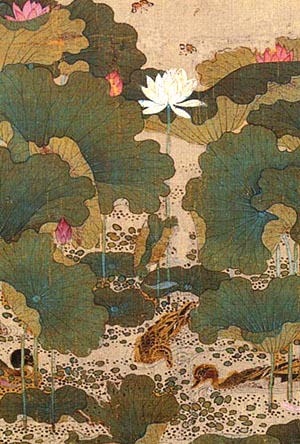
The water was dark
and shiny, like polished wood. Lotus leaves stood like parasols above
it, and trembled as fish wiggled through the stalks. The flowers were
white and luminous as teacups. I pulled one and handed it to Mai Lin.
"Here, " I said, " A flower for a flower!" and I asked
her to hold it by her face. I expected her to smile like a girl on a plate.
Instead she drooped the blossom across her shoulder like a kitten, and
her eyes went wide and apologetic, almost sad. That puzzled me,
and for weeks I would wonder about it. Finally, another person told me
that the lotus represents 'purity'. Apparently, Mai Lin was ashamed to
make that claim, because I was her second...
Mai Lin led us through a maze of blacktop until
we reached the highway. The concrete stretched like the horizon.
A white line ran down the center, and a few ragweeds peeped through the
cracks. Mai Lin seemed taken aback, and like many Chinese, even a little
embarrassed, so she said "China always poor--"
"Hardly",
I said, "This road looks just like America," and I meant it.
The white concrete, streaked by cars, reminded me of the roads on which
Americans spend so much of our waking lives; again, it was quite a contrast
to the dust and bricks of central China, where everything looks like it
was made by hand. I felt an ache which was odd, but small. I had been
in China for quite a while.
After
half an hour we saw a parasol, and a vendor selling the usual yogurt,
along with bottles of green and orange soda, and sacks of peanuts. However,
he also offered gold bars and silver coins made from foil, as well as
sheaves of incense and pseudo-money. I bought a few notes. They were printed
with tight lines of Chinese text, as well as 'Bank Of Hell' in English,
and a picture of the King Of The Dead. His dark eyes smoldered under a
miter board and a veil of beads.
Soon we left the
concrete and turned onto another asphalt road. We glided under walls of boxwoods. After a few hundred yards we reached the kind of pylon we
have on battlefields back home. With quiet dignity, Mai Lin showed me
what we had come to find.